The Agentic Enterprise Is Here: Why 40% of Enterprise Apps Will Have AI Agents by Year-End
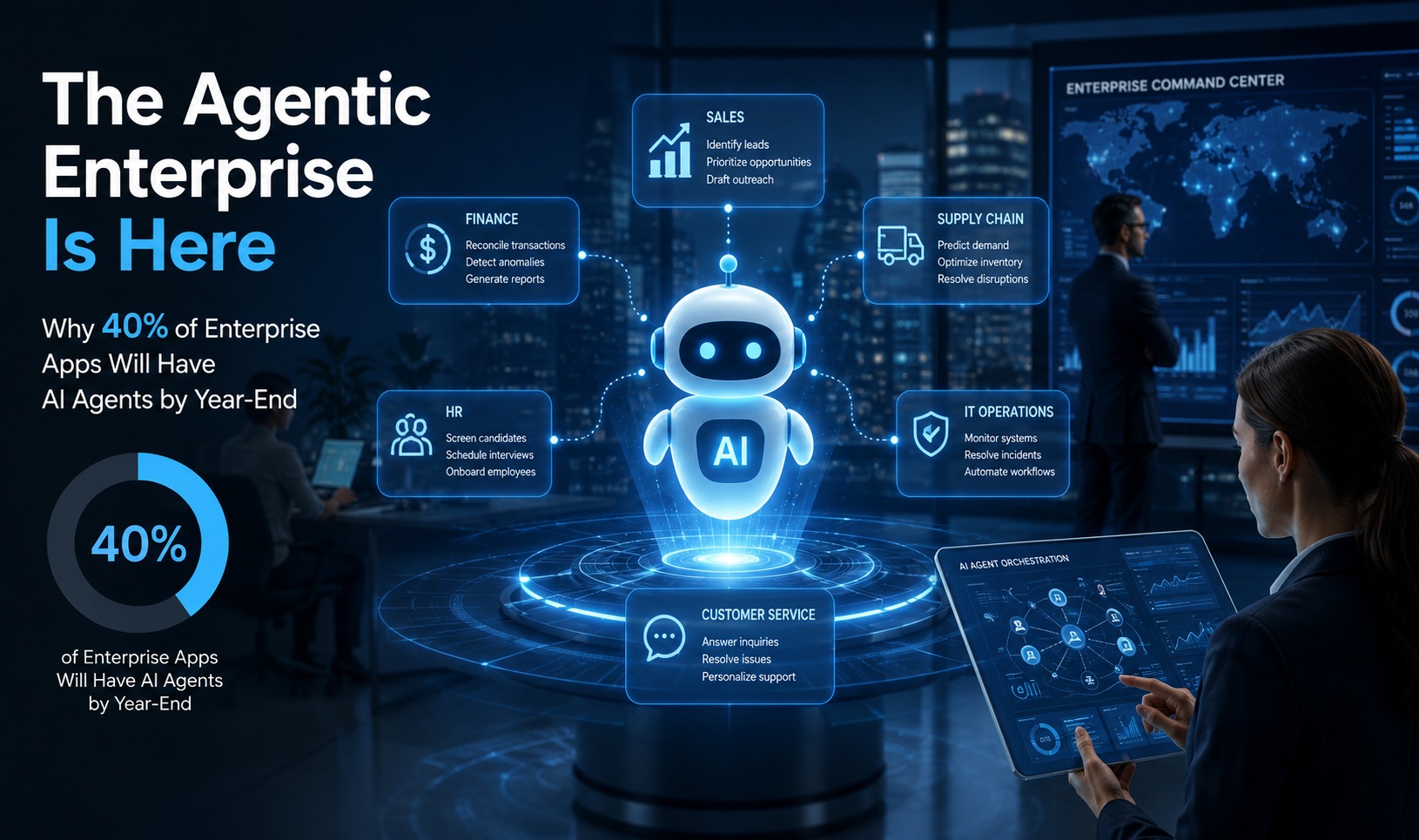
Something fundamental broke in the enterprise software world in early 2026 — and most executives haven’t felt it yet. While leadership teams debated AI strategy in boardrooms, a quiet threshold was crossed on the factory floor, in the back office, and inside customer service pipelines: AI agents stopped being a curiosity and started running the business. Gartner’s mid-year enterprise technology survey now projects that 40% of enterprise applications will incorporate autonomous AI agents by the end of 2026 — up from just 9% eighteen months ago. That is not a trend. That is a structural shift.
The question is no longer whether your organization will deploy agentic AI. It is whether you will be the kind of organization that knows how to operate it.
From Pilot to Production: Three Enterprises That Made the Leap
The gap between running an AI pilot and running an AI-powered operation is vast. Most companies have pilots. Very few have transformed. Three enterprises stand out in 2026 as genuine case studies in what full production deployment looks like.
JPMorgan Chase: The Compliance Agent Network
JPMorgan Chase quietly moved its document review and regulatory compliance workflows to a multi-agent architecture in Q1 2026. What began as a single-agent pilot handling Know Your Customer (KYC) documentation in 2024 has scaled into a coordinated network of over 200 specialized agents — each responsible for a discrete compliance domain — supervised by a layer of orchestration agents that manage handoffs, exceptions, and escalation paths. The bank now processes compliance documentation at a rate that previously required hundreds of contract analysts. More significantly, error rates on flagged filings dropped by 63%. The transformation required not just new software, but a new team: a dedicated Agent Operations Center staffed by what the bank internally calls Agent Orchestrators — human specialists who monitor agent behavior, tune guardrails, and adjudicate edge cases the system surfaces for human review.
Siemens: Agentic Manufacturing Intelligence
Siemens deployed its first production-grade agentic system across three smart factory sites in Germany and the Czech Republic beginning in late 2025. Agents now autonomously manage predictive maintenance scheduling, supply chain exception handling, and energy load optimization — tasks that previously required siloed software systems and constant human coordination. By Q2 2026, Siemens reported a 19% reduction in unplanned downtime across the pilot sites. The organizational transformation was just as striking: Siemens restructured its plant IT teams around an “AI Security Engineering” function, a role that did not exist in the company’s HR system two years ago. These engineers are responsible not for building agents, but for auditing their behavior, stress-testing their decision boundaries, and ensuring they cannot be manipulated through adversarial inputs in operational environments.
Walmart: The Autonomous Supply Chain
Walmart’s agentic supply chain initiative — now in full production across its U.S. distribution network — is arguably the largest enterprise agent deployment in retail. Agents handle supplier negotiation communications, inventory rebalancing decisions, and real-time logistics rerouting with minimal human intervention. The system processes millions of micro-decisions daily. What Walmart built on top of the technology is equally instructive: a formal Agent Governance Council that meets weekly to review agent decision logs, assess emerging risk patterns, and authorize expansions of agent autonomy thresholds. This council — not the technology team — holds the keys to what agents are permitted to do autonomously versus what requires human sign-off.
The Organizational Transformation Nobody Talks About
The technology press obsesses over models and benchmarks. Practitioners obsess over something harder: how do you actually run an organization where software agents make consequential decisions at machine speed?
McKinsey’s landmark 2026 report, The Agentic Organization, identifies the core organizational gap holding most enterprises back. According to McKinsey’s research, companies that successfully scaled agentic AI shared three structural traits: dedicated human roles for agent supervision, explicit governance frameworks defining agent authority boundaries, and operating models that treated agents as workforce participants rather than software tools. Companies that lacked all three — the majority — remained trapped in what the report bluntly calls “perpetual pilot purgatory”: running experiments that never compound into capability.
The new roles emerging inside leading enterprises deserve particular attention. The Agent Orchestrator is not a developer and not a traditional operations manager. They are a hybrid — fluent enough in AI system behavior to interpret agent reasoning traces, experienced enough in business operations to know when an agent’s output doesn’t pass the smell test, and empowered enough to intervene, retrain, or escalate. The AI Security Engineer is similarly novel: responsible for threat modeling the unique attack surfaces that autonomous agents introduce, including prompt injection in external-facing agents, privilege escalation risks in multi-agent pipelines, and the audit trail integrity required for regulated industries.
Google Cloud’s 2026 AI Agent Trends Report found that enterprises with formalized agent governance frameworks were 3.2 times more likely to reach production scale within twelve months of initial deployment than those operating without one. Governance, in this context, means something specific: documented escalation paths, defined autonomy tiers, regular behavioral audits, and clear accountability for agent decisions. It is less about restricting what agents can do and more about creating the institutional trust required to let them do more.
The 1% vs. the 89%
Here is the uncomfortable framing that McKinsey’s report surfaces and few executives want to sit with: when researchers mapped enterprise operating models against a spectrum running from “fully centralized, command-and-control hierarchy” to “decentralized adaptive network,” only 1% of enterprises operated at the network end of the spectrum — the model most compatible with agentic AI deployment. 89% remained firmly in industrial-age organizational structures: siloed functions, sequential approval chains, and decision rights concentrated at the top.
This matters because agentic AI is not merely a new software category. It is a new operating model. Agents make decisions in parallel, across functions, at speeds that hierarchical approval chains cannot keep up with. Organizations that have not distributed decision-making authority — into governance frameworks, into role definitions, into documented autonomy tiers — will find that AI agents expose every organizational bottleneck rather than dissolve them.
The enterprises winning in 2026 did not deploy AI agents into their existing operating model. They redesigned their operating model around the reality of AI agents.
What Separates Winners From the Perpetually Piloting
Across the enterprises that have successfully crossed from pilot to production, three patterns hold consistently:
- They treated agent governance as a product, not a policy. Governance frameworks were built, iterated on, and version-controlled like software — not filed in a PDF and forgotten.
- They created human roles before they needed them. Agent Orchestrators and AI Security Engineers were hired or retrained in advance of full deployment, not scrambled for after incidents.
- They measured agent behavior, not just agent output. The leading organizations tracked how agents reasoned — not just whether the end result was correct — because that is the only way to catch drift before it becomes a crisis.
The 40% threshold Gartner projects for year-end is not an aspiration — it is a deadline of sorts. By the time the majority of enterprise applications carry agentic capability, the competitive advantages will accrue almost entirely to the organizations that learned how to operate them, govern them, and build the human infrastructure around them. That learning takes time that most companies are not investing today.
The agentic enterprise is not coming. For a decisive minority, it is already here — and it is compounding. The real question every leadership team needs to answer is not whether to deploy AI agents. It is whether your organization has the operating model, the governance, and the people to deserve them.
Data referenced from Gartner Enterprise Technology Survey (2026), McKinsey & Company’s The Agentic Organization (2026), and Google Cloud’s 2026 AI Agent Trends Report. Enterprise case studies reflect publicly reported deployments as of Q2 2026.