The Lean AI Startup: How Founders Are Building $10M Businesses With Teams of 5
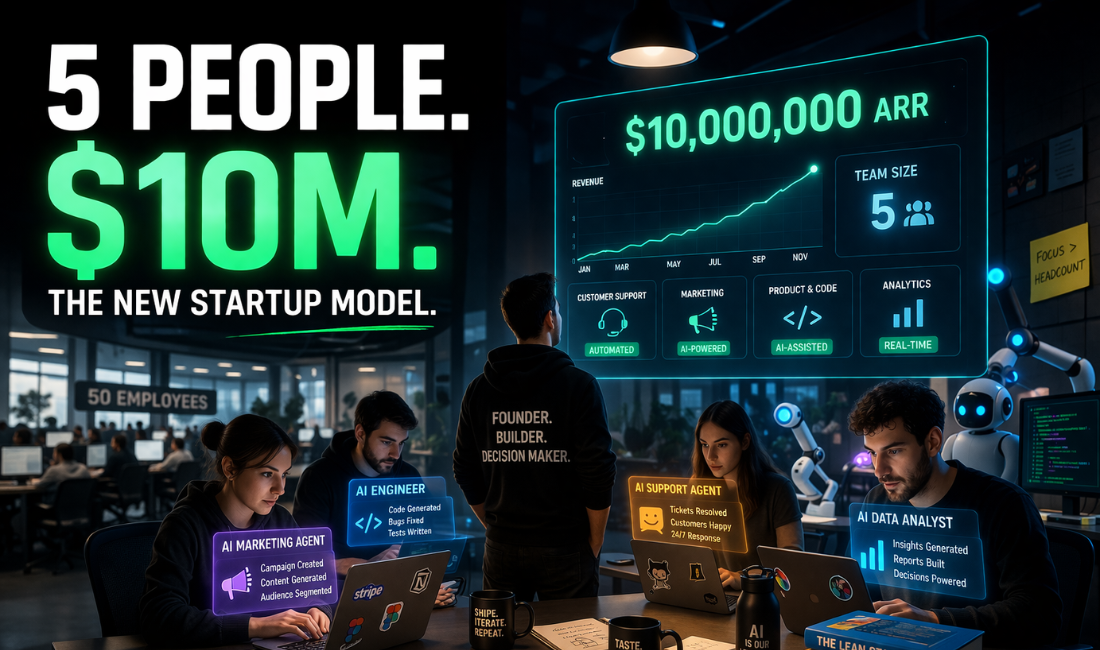
Not long ago, building a software company that crossed $10 million in annual recurring revenue was a milestone that implied something very specific: a growing sales team, a cluttered Slack workspace, a hiring freeze followed by a burst of hiring, and a Series A deck with an org chart that kept expanding. Scale meant headcount. Headcount meant scale. That equation is now breaking apart, quietly, rapidly, and perhaps permanently.
Across Silicon Valley, Bengaluru, London, and in remote corners of the internet where the next generation of founders writes code at midnight, a new kind of startup is taking shape. These companies are not small because they are early. They are small by design, and they are building that way on purpose. The tools available to a solo founder or a tight-knit team of five today are functionally equivalent, in many domains, to what a team of thirty could accomplish just five years ago. The productivity gap that once made large teams a necessity has been compressed, and for a growing number of founders, eliminated entirely.
The lean AI startup is not a bootstrapped side project limping toward profitability. It is a deliberately engineered machine. Founders in this wave have made a fundamental architectural decision early: every function that can be automated, should be. Marketing copy, customer support, data analysis, onboarding sequences, competitive intelligence, legal templates, each of these, which once required a specialist hire, is now handled by a stack of AI tools that costs a few hundred dollars a month to run. What remains for the human team is what AI genuinely cannot replicate yet: strategic vision, relationship-building with key clients, and the creative leap that produces a product category nobody thought to look for.
In the lean AI startup, the five people in the room are not generalists doing a bit of everything. They are a deliberate, complementary team of domain experts, each amplified by AI co-workers who never sleep, never ask for equity, and never miss a deadline. The founders who have cracked this model describe it not as cutting corners, but as cutting noise, removing every layer of organisational overhead that does not directly produce value for the customer.
“We replaced four full-time hires with three AI tools. Not because we couldn’t afford the people, but because the tools are simply better, faster, and available at 3 AM.”
Who Is Actually Doing This?
Look closely at the recent landscape of breakout SaaS companies, and you start to find them everywhere. Companies crossing $1M in annual recurring revenue within months of launch. Tools with six-figure user bases maintained by engineering teams of two. Niche vertical software products generating $3–5M in revenue with founders who have never made a single full-time hire outside their founding team. The pattern tends to follow a similar shape. A founder, often a repeat entrepreneur, often someone who watched a previous company struggle under the weight of premature scaling, identifies a narrow problem with a clearly willing-to-pay audience. They build a first version in weeks rather than months, using AI-assisted development. They acquire early customers through AI-enhanced content and community strategies. And they build a feedback loop tight enough to retain those customers before any well-funded competitor can react.
Companies like Tally, the form-builder run by just two founders and used by over a hundred thousand users, or Lemon Squeezy, the payments platform acquired while running on a skeleton crew of roughly ten people, are no longer curiosities. They are becoming reference points, proof that the lean model is not a compromise but a deliberate competitive strategy. Each of these companies made the same foundational bet: that leverage through AI tooling, smart automation, and ruthless focus could substitute for the headcount that conventional startup wisdom demands.
What This Means for Hiring, and Who Gets Left Behind
The implications for the hiring market are profound and, for many, uncomfortable. A generation of young professionals has been told that joining a fast-growing startup is the path to learning, equity, and career acceleration. The lean AI startup disrupts that pipeline. When a five-person company can perform the work of a twenty-five-person team, there are twenty fewer jobs to offer, and twenty fewer people learning by doing inside a growing organisation.
The roles most at risk are not the ones that conventional automation narratives focus on. It is not the factory floor worker or the truck driver who is being displaced by the lean AI startup. It is the entry-level marketing coordinator. The junior customer success manager. The associate product manager. The roles that were, until recently, the first rungs on the ladder for ambitious graduates are precisely the roles that AI handles with the most ease and the least complaint. What is emerging in their place is a new kind of employment dynamic, one where the five people inside the lean AI startup are extraordinarily high-leverage individuals who manage AI systems, prompt pipelines, and automated workflows rather than managing people. The skills in demand are not simply technical. They are meta-skills: the ability to think in systems, to evaluate AI outputs critically, and to know where automation fails and human judgment is irreplaceable.
“The first ten hires are no longer a rite of passage. They are a strategic choice, and most lean founders are choosing not to make them.”
Culture at the Speed of AI
Culture in a five-person company is both easier and harder than culture in a fifty-person one. Easier, because alignment is almost inherent, five people self-select into a shared vision, and the communication overhead of a small team means misalignment is visible and correctable within hours rather than months. Harder, because there is no culture team, no HR function, no manager whose job is to notice when someone is burning out. In the lean AI startup, the founders are the culture, and when the founders push hard, everyone pushes hard.
This creates a particular kind of pressure that is not yet widely discussed. AI tools are extraordinarily productive, but they shift the burden of judgment entirely onto the humans who use them. Every output from an AI agent requires a human decision: is this good enough? Does this match our voice? Is this the right call for this customer? In a traditional team, that cognitive load is distributed across many people. In a team of five, it concentrates intensely. Founder burnout in the lean AI startup era is not from doing too little, it is from deciding too much. The founders who manage this well are deliberate about building systems that minimise unnecessary decisions and protect the cognitive bandwidth required for the judgments that actually matter.
Valuation in a World Without Headcount
For the venture capital world, the lean AI startup presents a genuine puzzle that has yet to be fully resolved. Traditional startup valuation frameworks lean heavily on team size as a proxy for ambition, execution capacity, and defensibility. A twenty-person team signals that a company is serious. A hundred-person team signals that it has momentum. A five-person team generating $10M in ARR simply does not fit the model, and investors are visibly uncertain about how to respond.
Some investors, particularly those who have spent time inside AI-native companies, are recalibrating fast. They have seen what a well-architected lean team can do, and they understand that revenue-per-employee is becoming the new signal, replacing raw headcount as a measure of operational excellence. A lean AI startup generating $2M in revenue per employee is not a company that failed to hire. It is a company that solved a problem most companies have not yet noticed they have. Others are slower to adapt. There remains a meaningful cohort of institutional investors who view a small team as a scaling risk rather than a structural advantage, who worry that a five-person company cannot handle enterprise sales cycles, cannot manage complex partnerships, and cannot sustain the pace of product development required to stay ahead of larger competitors. These concerns are not entirely wrong. They are, however, increasingly outdated as the capabilities of AI tools expand into each of these domains.
“Revenue-per-employee is becoming the new north star metric. A team of five generating $10M is not under-resourced, it is optimally resourced.”
The Risks Nobody Talks About Loudly Enough
It would be incomplete to talk about lean AI startups without acknowledging their fragility. With a five-person team, there’s no real backup, if a key founder steps away or loses focus, the company feels it immediately. Knowledge is concentrated, and AI only amplifies the judgment of the people behind it, not replaces it.
There’s also a growing competitive risk. The same AI tools that give lean teams an edge are accessible to larger, better-funded companies. Agility helps early on, but it’s not a permanent moat, once bigger players pay attention, they can move just as fast.
And then comes the challenge of quality at scale. Automation works well in the early stages, but as complexity and customer expectations grow, especially around the $5–8M ARR mark, human judgment becomes essential again.
The lean model is powerful for getting started, but whether it holds as the company grows is the question every founder eventually has to face.
The Road Ahead
The lean AI startup is not a temporary phenomenon born of a particular moment in AI capability. It is the early iteration of a permanent structural shift in how companies are built and what it means to scale. The playbook is still being written, by founders who are learning in real time which functions can be handed to AI and which ones demand the irreducibly human quality of wisdom under uncertainty. What seems increasingly clear is that the competitive moat of the future will not be built from headcount. It will be built from taste, judgment, and the ability to direct AI tools with a clarity of vision that produces outputs that feel, to customers, unmistakably human.
The five-person company that achieves this will be more durable, more profitable, and more interesting than the fifty-person company that never had to figure it out. The lean AI startup is not the future of every company. But it is the future of the first chapter of most of the best ones, and the founders who understand that early are already building businesses that will redefine what it means to start something from scratch. The era of scale as spectacle is ending. The era of scale as craft has quietly begun.