AI Agents Are Replacing Entire Job Roles & Not Just Tasks
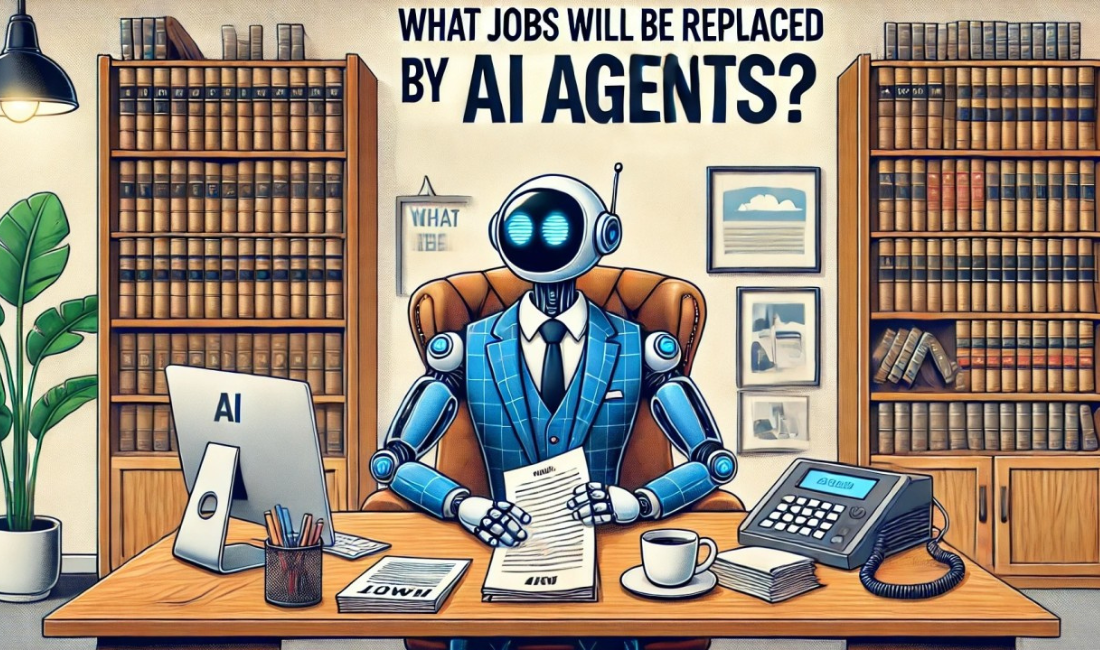
For years, artificial intelligence was positioned as a helper, a tool that could assist humans in doing their jobs faster. It could draft emails, automate repetitive actions, and provide recommendations. But the responsibility of actually getting work done still rested with people.
That assumption is no longer holding true.
We are now witnessing a fundamental shift where AI is evolving from a passive assistant into an active participant in business operations. More importantly, it is beginning to take over not just isolated tasks, but entire job roles. This transformation is subtle on the surface, but deeply disruptive underneath.
From Assistance to Autonomy
The earlier generation of AI systems was reactive. You asked a question, and it responded. You gave it a task, and it executed that specific instruction. It had no memory of broader goals, no understanding of context beyond the immediate query, and no ability to act independently.
Modern AI agents operate very differently.
They are designed to:
- Understand goals rather than just instructions
- Maintain context across multiple steps
- Make decisions based on data and patterns
- Execute workflows end-to-end
This means businesses are no longer interacting with AI as a tool, but as a system capable of handling complete processes. Instead of guiding every step, companies define the outcome, and the AI figures out how to achieve it.
The Real Shift: From Tasks to Roles
Most conversations about AI focus on task automation. However, the more important shift is happening at the level of job roles.
A job is essentially a bundle of tasks. When AI starts handling a majority of those tasks, the role itself begins to dissolve.
Take customer support as an example. Traditionally, a human agent would read queries, look up relevant information, respond to the customer, and update internal systems. Today, an AI agent can manage the entire workflow, from understanding the query to resolving the issue and logging the interaction.
A similar transformation is visible across multiple functions:
- Sales and marketing: AI identifies leads, drafts personalized outreach, sends follow-ups, and tracks engagement.
- Operations: AI systems manage workflows, process documents, and flag inconsistencies.
- Finance: Automated agents handle invoices, detect anomalies, and execute approvals.
In each case, the shift is not about replacing a single step. It’s about automating the entire chain of activities that once defined a role.
Why This Shift Is Accelerating Now
This transition is not driven by hype alone. It is rooted in strong economic and technological forces that make adoption almost inevitable.
First, the economics are compelling. AI systems operate continuously, scale instantly, and reduce the marginal cost of work. For businesses, this translates into faster execution and lower operational expenses.
Second, organizations are redesigning their processes. Earlier, AI was layered onto existing workflows. Today, companies are rebuilding workflows from scratch with AI at the center. This “AI-first” approach is proving far more effective.
Third, the focus has shifted from intelligence to execution. Businesses no longer need tools that simply generate information. They need systems that can act on that information and deliver results. AI agents fulfill that requirement.
Are Jobs Actually Being Replaced?
The answer is nuanced.
There is clear evidence that certain roles are already shrinking, particularly in areas like customer support, back-office operations, and routine analysis. These functions are structured, repetitive, and data-driven, making them ideal for automation.
However, full replacement is not yet the reality. AI still struggles with ambiguity, complex judgment, and strategic decision-making. Most systems require human oversight, especially in high-stakes environments.
What we are seeing today is not a sudden disappearance of jobs, but a gradual restructuring of work.
The Deeper Reality Most People Miss
The impact of AI on jobs is not binary. It unfolds in layers.
Roles rarely disappear overnight. Instead, AI gradually takes over portions of the work. As more tasks become automated, the role loses its core function. Eventually, it becomes redundant.
This process disproportionately affects mid-level roles. Entry-level jobs often remain cost-effective, while senior roles involve strategy and leadership. Mid-level positions, which focus on coordination, analysis, and execution, are the most exposed.
At the same time, companies are becoming leaner by design. With AI handling execution, organizations require fewer people to achieve the same or even greater output. This is leading to a structural shift in how businesses are built and scaled.
Another critical change is in competitive dynamics. Previously, companies gained an advantage through larger teams and greater resources. Now, the advantage lies in having better AI systems and more efficient automation. This redefines what it means to be competitive in the modern economy.
What the Next 5–10 Years Will Look Like
Looking ahead, this trend is expected to accelerate and mature, reshaping both businesses and the workforce.
AI agents will increasingly function as digital employees. Companies will deploy AI systems for roles in marketing, sales, operations, and analytics. These systems will not feel like tools, but like integral members of the organization.
Entire departments are likely to become AI-first. Customer support, operations, and finance functions will rely heavily on automated systems, with humans focusing on oversight and strategy.
Productivity will rise dramatically. Individuals equipped with AI will be able to produce output that previously required entire teams. This will reduce hiring needs while increasing the intensity of competition.
Another major development will be the rise of multi-agent systems. Instead of a single AI handling everything, multiple specialized agents will collaborate, one for research, another for decision-making, and another for execution. This will resemble a digital organization operating within a company.
The job market will not simply shrink; it will evolve. While routine roles decline, new roles will emerge around managing, designing, and auditing AI systems. Skills related to strategy, creativity, and human judgment will become more valuable.
At a broader level, the economy may move toward a winner-takes-all dynamic. AI systems scale rapidly, allowing the best solutions to dominate markets. This could widen the gap between leading companies and the rest.
Final Perspective
It is easy to frame this shift as AI replacing human jobs. But that perspective misses the bigger picture.
What is really happening is a transformation in how work itself is performed.
In the traditional model, humans were responsible for execution, supported by tools. In the emerging model, AI handles execution, while humans provide direction, oversight, and strategic thinking.
Closing Thought
The real challenge is not whether AI will replace jobs, but how individuals and organizations adapt to this new paradigm.
Those who learn to work alongside AI, leveraging it as a workforce rather than just a tool, will gain a significant advantage. Those who don’t may find themselves competing not against AI directly, but against people who know how to use it effectively.
In this new era, success will depend less on effort alone and more on the ability to amplify that effort through intelligent systems.